FAQ For Educators
Why was Muddy Sneakers started?
In a 2002, report called Closing the Achievement Gap was published by the State Education and Environmental Roundtable with findings from a nationwide study involving 150 schools. The report summary reads in part:
Environment-based education produces student gains in social studies, science, language arts, and math; improves standardized test scores and grade-point averages; and develops skills in problem-solving, critical thinking and decision-making.
Following this report, in 2005 Richard Louv’s Last Child In The Woods was published and immediately received international recognition for it’s addressing of the detrimental effects of a childhood removed from nature. It was here that Louv first coined the term ‘Nature Deficit Disorder’ as a means of describing the current generation’s disconnect with the natural world. Louv’s work was embraced throughout the fields of education, psychology, science and political science and the conversation has yet to slow down. In response, conversations on the topic have spread far beyond the traditional environmental education circles and have even reached the highest levels of government as seen in the three different versions of a bill referred to as the ‘No Child Left Inside Act’ (NCLIA) presented by the United States Congress, with consistent bi-partisan support, since President Obama’s first term in office. Although yet to be passed, the NCLIA offered a progressive approach for integrating environmental education into the reauthorization of the existing No Child Behind Act and would have allowed for increased funding to schools and third-party programs, like Muddy Sneakers, who are working closely with schools to improve their EE offerings. The simple proposal of this bill has had a strong impact in organizing and motivating the EE community to better define what it means to be ‘environmentally literate’ and how that can be measured in a way so that EE is no longer viewed as ancillary to traditional public school instruction but rather a critical, multi-discipline component of a child’s formative education.
Inspired by the possibilities expressed in the 2002 report, the data presented by Richard Louv and the clear local/regional need to better connect students with the incredible outdoor classroom opportunities in western North Carolina, Muddy Sneakers was conceived and designed to deeply integrate North Carolina’s Standard Course of Study in science with a field-based curriculum that is consistent, active and exploratory.
How does the Muddy Sneakers program operate?
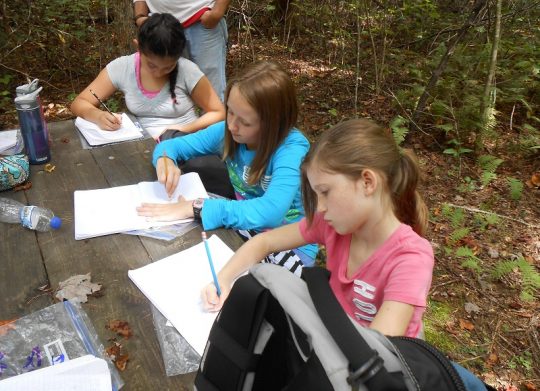
Weaving together a curriculum that builds on itself, schools commit their 5th grade students to spend between 6-10 full school days, spread over the course of the academic year, participating in Muddy Sneakers’ experiential education program. There is flexibility in the order in which the curriculum topics are taught and Muddy Sneakers is happy to tailor that scheduling to the needs of the individual school. Each MS ‘expedition’ is thus based on a core science topic as dictated by the state curriculum. Whether in the field or on the schoolyard, each class of students is separated into groups no larger than twelve students per one instructor, with each group being accompanied by one additional teacher/chaperone.
Muddy Sneakers instructors are highly qualified naturalist educators and bring a diverse array of experiences and teaching styles to the program. Over the course of a year, every child will have the opportunity to learn from a variety of instructors, each with the goal of connecting their students with their surroundings through seeing, touching, smelling and ultimately understanding the science curriculum as it unfolds before their eyes. Regardless of the number of expeditions chosen (with six being the minimum), each school will participate in a critically important introductory Day 1: School In The Woods expedition. During this first day, students become oriented to the program, the structure and flow of a Muddy Sneakers day, the incorporation of the scientific method and ideally leave better prepared to participate in a year of active learning in an outdoor classroom setting. To facilitate a safer learning environment for students, during the Day 1 curriculum, students learn what to do if groups encounter wildlife, how to identify poison ivy, how to safely use the bathroom in the woods, and how to use a map and compass.
During the 2016-17 school year, Muddy Sneakers is also working to create additional pre- and post-expedition support materials with the help of a few of our most dedicated teachers. These will be completed by the conclusion of the school year and will be made available as they are completed. These will be further refined in the years ahead and again, feedback is encouraged as Muddy Sneakers works to better support those schools willing to invest in the program and those teachers looking for further assistance in preparing students for the field and ‘closing the circle’ back in the classroom.
Muddy Sneakers also offers an optional End-of-grade (EOG) Review where staff will come to the school for a nominal additional cost and help students review those key science topics learned on Muddy Sneakers expeditions that year. Typically one or two staff will be on hand to rotate between the different science classes spending approximately two hours with each class and using both indoor classroom space and the schoolyard.
Why does Muddy Sneakers lead Off-site and Schoolyard Expeditions?
The schoolyard expedition format came about for a number of different reasons. Muddy Sneakers wanted to further explore teaching appropriate expedition topics on school grounds as an alternative to the field as a means of better understanding how the expedition format would translate to schools located in areas where there was not such a wealth of protected lands/natural areas in close proximity. A secondary reason was to teach students and teachers alike about the outdoor classroom available to them in their own backyard. The final major reason the organization chose to commit time and energy to exploring this format, beginning in the 2011-12 school year, was to provide the Muddy Sneakers program at a reduced cost to the schools and the organization during a time of financial instability in both the school system and throughout the non-profit world. The schoolyard model involves fewer instructors for those schools with 40 or more students due to the format of splitting the 5th grade class into two groups with only half of the grade participating at a time (groups switch after lunch).
The 2011-12 school year, when each school participated in more schoolyard then field expeditions, was an excellent learning experience for all parties. Although Muddy Sneakers believed then, and continues to, that there was reason to further refine its schoolyard model, the decision was made beginning in 2012-13 to offer each school the choice of participating in as many as, but no more than, two (2) schoolyard expeditions per year. Subsequently, each school will then participate in at least four (4) field expeditions utilizing sites ideally located no further than 30-40 minutes from the school campus.
Does the Muddy Sneakers curriculum reflect the current NC and SC State Standards for 5th Grade Science? Will there be further refinement should NC decide to adopt the Next Generation Science Standards (NGSS)?
Yes, Muddy Sneakers’ Curriculum Team in collaboration with participating teachers/administrators/advisors successfully overhauled the Muddy Sneakers curriculum following the 2011-12 school year and in advance of NC’s introduction of the Essential Science Standards in 2012-13. The introduction of these standards required Muddy Sneakers to revise almost half of its curriculum topics. Since that time, the new topics that have been fully explored and refined. In preparation for the launch of the Upstate SC Expansion Pilot in 2015-16, Muddy Sneakers’ Curriculum Team revised the NC curriculum to meet the somewhat unique aspects of South Carolina’s state science standards and in the process, were able to use topics previously shelved from the previous iteration of the NC curriculum. The current SC Curriculum is a pilot version of what the organization expects will grow into an eventual offering of at least eight (8) topics, again providing teachers the opportunity to select which topics best suite their needs should the school not be able to participate in more the minimum six (6) expeditions. Below is a complete list of both the current NC and SC Muddy Sneakers expedition topics:
North Carolina: Muddy Sneakers Expedition Topics
Day 1: School in the Woods
Weather
Terrestrial Ecosystems
Ecosystem Interactions
Aquatic Ecosystems
Forces and Motion
Inheritance and Adaptation
Living Systems
Matter: Properties and Change
Energy: Conservation and Transfer
South Carolina: 2015-2016 Muddy Sneakers Expedition Topics
Day 1: School in the Woods
Terrestrial Ecosystems
Ecosystem Interactions
Land Forms
Aquatic Ecosystems
Forces and Motion
Matter
In NC, the state’s decision to update the curriculum for 2012-13 provided Muddy Sneakers the opportunity to reevaluate its work and reflect on lessons learned from the first four years in operation. In addition to revising the old expeditions and writing curriculum for each new topic, the organization felt it was an appropriate time to introduce a greater inter-disciplinary emphasis into each expedition in an effort to develop a more holistic approach. In 2012-13, Muddy Sneakers began to creatively intertwine some of the national (and NC adopted) ‘Common Core’ math and language arts standards into the teaching of the science curriculum. It is the organization’s desire to not only stay current but also serve as a resource to participating schools as they continue to work through the updated curriculum. Thus our instructors make themselves available as often as necessary to teachers who have additional questions or seek guidance into how best to approach any of the science topics with which they are tasked to instruct. Finally, as the program was evolving, staff and administration alike felt more could be done to offer students an opportunity for silent reflection while in these natural settings and since then it has become a priority of each expedition experience.
What outdoor skills will my students learn on Muddy Sneakers Expeditions?
On their first Muddy Sneakers Expedition, students become oriented to the program, the structure and flow of a Muddy Sneakers day, the incorporation of the scientific method and ideally leave better prepared to participate in a year of active learning in an outdoor classroom setting. To facilitate a safer learning environment for students, during the Day 1 curriculum, students learn what to do if groups encounter wildlife, how to identify poison ivy, how to safely use the bathroom in the woods, and how to use a map and compass. These skills are used throughout the year of Muddy Sneakers Expeditions.
Where do the students go for their Off-site field Expeditions?
We’d argue it’s hard to get your sneakers muddy if you’re spending most of your day on the bus! Thus, Muddy Sneakers is committed to staying within 30-40 minutes of each school’s campus (varied only for exceptional circumstances). This also helps students connect with and better educate themselves about the natural resources available to them in their community. The natural treasures found in Western North Carolina and Upstate South Carolina, a land of streams, escarpments, hardwood forests, rock domes, wetlands and waterfalls, create a joy-inducing theater for teaching and learning. While we are always seeking new field sites, our most common expedition locations in WNC currently include DuPont State Recreational Forest, Gorges State Park, Lake James State Park, NC National Forests (Pisgah and Nantahala Districts), Carl Sandburg National Historic Site, as well as many others. In Upstate SC, where the portfolio of sites and partner relations is ever-expanding, Muddy Sneakers is excited to initially be utilizing county and city parks in Greenville County and parterning with the SC Department of Natural Resources to use heritage preserves in Spartanburg. Building on the successful relationships to date with local conservation partners Carolina Mountain Land Conservancy and Southern Appalachian Highlands Conservancy, Muddy Sneakers will continue to pursue opportunities to partner with similar land conservation organizations in the future in an effort to further educate students about the private efforts made to protect lands in perpetuity.
What is my expectation as a teacher involved in Muddy Sneakers?
As a teacher participating in Muddy Sneakers, you are asked to be an active and engaged participant in your school’s experience, to partner with our field instructors to make the most of the outdoor classroom and to offer ideas, notes, encouragements and criticisms to the Muddy Sneakers administration and field staff in an effort to constantly improve and refine the program. We also ask each teachers to assist us in evaluating the quality of the program/experience and we provide multiple opportunities to do so throughout the year. Please know feedback is always appreciated and welcomed at any point as we strive to serve the needs of every school and provide a positive experience for students and faculty alike.
A common theme among participating schools that seem to take the most from the Muddy Sneakers experience is the presence of invested teachers that champion the program and use it to further enhance their work in the classroom. Muddy Sneakers was never intended to be a substitute for classroom instruction but rather a complementary program that brings to life what might otherwise be limited to a textbook experience. We encourage teachers to ask questions of our staff and utilize their expertise in seeking to improve can be done back on school grounds to maintain the enthusiasm for science that Muddy Sneakers strives to create.
Each participating school is also asked to assign one ‘Lead Teacher’ and Muddy Sneakers will in turn assign each school one ‘Lead Instructor.’ The relationship between these two lead roles has proven critical to the success of the Muddy Sneakers program. If you are your school’s Lead Teacher, for that year you will serve as the primary point of contact at the school for MS staff and administration and you will also play an important role in disseminating information to your fellow school staff. The Lead Teacher is generally responsible for communicating with the Muddy Sneakers Program Director to schedule your school’s expedition dates (which are handled on a first-come, first-serve basis and can be done as soon as your school signs the MS Commitment Letter for the following school year, generally as early as May). The Lead Teacher will also be involved in communicating with their Lead Instructor when there is inclement weather forecasted and about any logistical matters of importance that could impact the expedition day. Muddy Sneakers hopes all Lead Teachers will be advocates for the program and willing to work with their fellow staff to fully realize the benefits of the program and how to make the most of the additional field experience.
What has been the impact of Muddy Sneakers to date?
Muddy Sneakers sees its program as somewhat unique in that we strive and wholeheartedly subscribe to the importance of quantifying the program’s impact. The organization sees a true need to further integrate experiential science education into the traditional school format and sees this program as a bridge between the worlds of ‘formal’ and ‘non-formal’ education given the program’s repeat exposure and deep integration of state standards. While the environmental education community continues to grapple with how best to measure its impact and move beyond the qualitative and into the quantitative data, Muddy Sneakers continues to prioritize time, energy and financial resources towards moving that bar forward.
Muddy Sneakers is very excited to be working with a talented group of academics at North Carolina State University on a two-year research partnership beginning fall 2015 and concluding spring 2017. During this time, the program will be analyzed and used as a model for the development of an innovative elementary-specific, environmental literacy measurement tool (the first in the nation). This incredible opportunity marks a key advancement in the organization’s ability to quantifiably measure program success via a unique EE tool that more specifically reflects the impact of the Muddy Sneakers experience.